Monday, February 17, 2020

The First Sound

I advocate learning the shakuhachi at the onset with a teacher in person as it can greatly prevent unnecessary mistakes that if left unchecked becomes a deep rooted habit that impinges growth and development.

Learning the shakuhachi one can encounter a major paradox: it is both easy and difficult to produce a good sound.

It can be described as playing with ease because a relaxed mind-body produces clear, resonant notes. But the challenge is in the player because such relaxation is counter intuitive especially for a beginner.
Untitled
In the beginner's mind it often becomes a struggle between the self and the instrument. There can be much striving to master the instrument via controlling the body. There is also the lack of patience especially in the current technogical age where the idea of instant gratification is lavished on us.

Bodily awareness requires mindfulness -- being mindful of sensations, movements, positions, and understanding how these are linked to sound production. Both interoception and proprioception are needed. Proprioception would include learning to be aware of lip tension, mouth cavity volume, finger contact position, and even vibrations of the flute. Interoception would include learning to be aware of abdominal breath activation, volume of breath, and internal rhythm. 

Awareness leads to fine adjustments that unlock the rich sounds of the shakuhachi. Such awareness does not come naturally, thus the need for hours of practice to build it up gradually, and for retention in body memory to take place.

This also means there can be no single standard set of steps to ensure one gets a first sound on the shakuhachi because each learner has unique anatomy, degrees of awareness, and ability to relax.

Initial guidance fortunately can still help the self-learner. They are like markers left by preceding travellers on their own learning path. We just need to try and use what works for us.

Here are some resources to get started. But the rest of the journey we have to figure it out on our own.


In English:
Jon Kypros
https://youtu.be/vsLZmSCr7r4

Shawn Renzoh Head
https://youtu.be/mQChlXy7kDM

Alcvin Ryūzen Ramos
https://youtu.be/HC_Yij3Nl0I

Perry Yung
https://youtu.be/in-Ifh-s7R8


In Mandarin:
Flying NaN
https://youtu.be/86j60SmSs8E

周文壕
https://youtu.be/Z9cLU6vST50
https://youtu.be/cW8a9rrqkUU


In Japanese:
Keisuke Zenyoji
https://youtu.be/LGhhQEWzzuI

三塚幸彦
https://youtu.be/Xp7nnaKQiqE


Intermediate/advanced (in Mandarin):
Winson Liao 廖錦棟
https://youtu.be/bzApkJ-HeXw
https://youtu.be/jTmtGUTYz7Y


Bamboo Grows in Marble

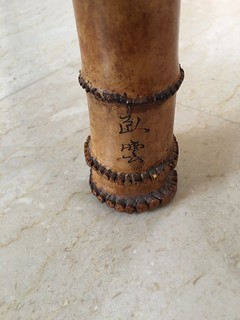
17 Feb 2020Shakuhachi flutes have a certain appeal as they are specially made with root ends from mature bamboo. The beauty of the smooth stem contrasts with the gnarly roots, reminding us that life manifests in similar fashion: happiness and suffering are not separate.

Bamboo's appearance is deceptive, looking like a tree but is actually a grass. In fact it is often viewed as an unwelcome weed because it is difficult to eliminate once it populates an area.

Harvesting it is a tedious manual task in the first stage of flute making. It would seem the plant lost its life, but at the hands of a craftsman it takes on a new life, transformed from a weed into a lively instrument. In the Edo period of ancient Japan it was regarded as a dharma instrument (法器, hoki) that helped monastics in their meditation practice. The humble bamboo continues beautifully in a new form, the shakuhachi (尺八) -- "death" does not bring an end. 

Monday, February 3, 2020

Beauty in Imperfections

The Shakuhachi (尺八) is elegant through its simplicity - 5 finger holes being sufficient to bring out the chromatic scale reaching up to 3 octaves.

It is interesting how the Japanese innovated on this by looking outside of the box. A typical wind instrument has precise finger holes to determine the pitch. To illustrate, a hole can be in two states, either opened or closed, and each state produces its own pitch so there are two notes available.

Untitled
For the Shakuhachi, each finger hole has a wider diameter than say a Xiao or recorder. This means each hole can be partially covered or shaded to access the finer pitches in-between two discrete notes. This in itself is not unique as there are other flutes like the North American Flute (NAF) that have half-hole techniques.

For greater versatility, the Shakuhachi can be blown with variation in the angle between the blowing edge and the lips (embouchure). And this gives the performer another means to control pitch. Such pitch variations through head tilting plus instrument shifting is also used for vibrato effects.

For example, the note D is played by covering all holes (on a 1.8 Shakuhachi) while lifting finger off the first (lowest) hole plays F. The notes E and Eb (E flat) are "hidden" between D and F. Magically through partial fingering and angle adjustment, these notes shyly manifest.

These "half" sounds are usually softer in volume and differ in timbre from a fully opened/closed finger hole note. Such imperfections contribute to the distinct sound signagure of a Shakuhachi, enriching the palette available to an expert player to convey different moods and imagery.

There is an inherent "uncertainty" or variability to each note produced, therefore the same song can sound anew when repeated even by the same performer.

Monday, January 20, 2020

Dragon Leaping, Phoenix Prancing; Dong Xiao of the North, Shakuhachi of the South

龙腾凤舞;北有洞箫,南有尺八

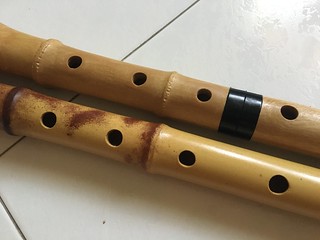
19 Jan 2020.Left: DG Xiao from Winston Liao.Right: 1.8 D Shakuhachi (Bell) from Jon Kypros.
Took a break yesterday from practising the Shakuhachi 尺八 so my Xiao 箫 won’t go rusty (rather to prevent mould).
Putting the two side by side shows the contrast in appearance 小巫见大巫. Actually they each have their own “powers”; one can’t say the dragon is more superior to the phoenix.

The two instruments have a common history but naturally developed into a kind of Yin and Yang 太极生两仪 after the Tang dynasty. The Shakuhachi is like the majestic dragon that bursts into mighty leaps and wreaks stormy weather. It can be a tough ride on such a beast, needing stability and strength. When it’s rested there’s still tension, a dormant energy 藏龙.

The Xiao is refined and elegant like the phoenix gliding through the clouds. Soothing and flowing sounds are deceptively simple - execution requires tempering the power of the breath. Patience and virtue seems to be the foundation. A certain Romanticism surrounds this instrument with tales of love match made through music and ascensions into the heavens 吹箫引凤.
The Shakuhachi frees the spirit and the Xiao calms the senses, at least that’s my perception. Just like how Yin and Yang are interdependent, the dragon can have phoenix like qualities and vice versa.

Shakuhachi and Xiao duet:
On practical experience, the Shakuhachi having a wider bore does require a firm breath before a good tone is produced, whereas on the Xiao one may get away with it for a while before it becomes an obvious problem. Both instruments are driven by abdominal/diaphragmatic breathing coupled with lower dantian 下丹田 control. The lungs are secondary in support. Switching back to the Xiao was an unusual feeling (beyond adapting the embouchure) as I had to adopt a more restrained 内敛 approach so as not to overpower the instrument.

Technical notes: the Shakuhachi 尺八 referred to here is the traditional Japanese 5 holed bamboo instrument with a slanted cut at one end for blowing. There are actually variants of this in Chinese culture referring to the Southern Xiao 南箫 as 尺八 also. And to add confusion there are 6 and 8 holed Xiao using the same style of blowing edge as Shakuhachi. One way to look at an instrument is not to decouple it from its culture and history: the Shakuhachi includes the approach and nuances of playing, its notation system, it’s link to Zen practice, its relationships to other instruments such as koto, and the craftsmanship of making it.

Saturday, January 18, 2020

Mantra 2: It's not the instrument (it's insufficient practice)

Perhaps it is human nature that when things go wrong we easily externalize and blame everything else. It could be a way of survival, being self-centred, or reflecting a need to feel in control.

In my encounter with my new shakuhachi (or it could be anything new in life such as a person) there was that bit of doubt: is this tuned correctly, does it have some flaw, would a more expensive piece be better. Fortunately in the case of an instrument, the teacher can use his experience to clear such doubts, and the student has to honestly face his own shortcomings and practise more!

This creates spaciousness and clarity for the student to grow with the instrument. There is confidence that comes from the solidity of a teacher. Herein lies a parallel with therapy where clients similarly benefit from the solidity of a counsellor who does not waver in the face of confusion, chaos, uncertainty.       

Another challenge is self awareness and in the shakuhachi (or any music) it's about the pitch, volume, and tempo while playing the instrument.
13 Jan 2020
I had assumed that I was sustaining a regular tempo while practising. not realizing that I often slow down as a piece progressed. I suppose our mind plays tricks on us when there is some distraction that may come from fatigue/stress. Sometimes it could be due to our emotional shifts that affect the pace.

In the end, I needed to invite an old "teacher" to resume work: the Nikko mechanical metronome. It was bought eons ago when I learnt the classical guitar and languished when I suffered a finger injury which led to the "break-up" with guitar. There's something assuring about this simple mechanical tool in comparison to the modern electronic version. It has greater presence that cuts above my own playing compared to a beeping/blinking version. Like a Jedi master, my teacher guided me back to the "ancient" ways of metronome practice.

Tuesday, January 7, 2020

Mantra 1: Use the (full) Force

I had to get reacquainted with this approach of practising for rim-blown wind instruments that somehow I had overlooked. It's more likely that I had gotten complacent or "lazy" and had been putting attention on the pitch quality rather than getting a full bodied sound.

There is now greater clarity why practising with full force is helpful (other than breaking a sweat). This is the means to explore the periphery of the instrument's limits, for example, when does a note break and cross into overtones. That threshold is also the point where the sound can be full bodied with greatest resonance. And there's a certain logic that when one can use full force then tuning it down poses less of a problem, which then avails us a more dynamic range to portray a piece of music.

This video of shinobue master Yasukazu Kano (2018 Traditional Flute Festival) helps illustrate what I mean. It is rather liberating when the breath feels unrestricted.

Untitled

Thus it is very fortunate to have a teacher to point out blind spots such as these. The shortcoming of self learning is that we tend to swing one of both ways: either be too self critical and give up, or too contented and remain stagnant. Of course, such outcomes are not "wrong" as long as we can accept it. So I guess my yearning helped drive me forward.

The new year was a tough period of experiencing another seasonal flu onslaught. Flu can be frustrating because it affects the breathing system and introduces aches that bring lethargy.

It can also be a fruitful experience of persisting with shakuhachi training. And this brings another lesson: how we can still practise but not having to be perfectionistic about the sound quality. This aspect probably highlights one of my weaknesses, the tendency to seek perfection.

It can be quite paradoxical but it works: continue to practise with full force and disregard the slight variations in quality. After a period of time the tone will improve. Looking back, I tended to compromise by blowing with less force, that is, playing it too safe/conservatively.

Tuesday, December 31, 2019

New Winds from the Rising Sun

My journey with wind instruments and its music starts on a new track with the formal learning of the shakuhachi (尺八). It is a beautiful mystery how connections are made from one thing/person to another. I believe part of it is driven by one's aspiration and being open to explore what comes up before us.

In struggling to master the Tang embouchure Xiao (唐口箫), I realized a suitable teacher was needed and the usual Xiao/Dizi teachers were unlikely to be equipped. Unfortunately being unable to leave the country, I couldn't go get guidance from the well known craftsman himself who's based in Taiwan. There was some self doubt and uncertainty because the shakuhachi was no mere instrument, it embodies the rich culture and traditions of Japan, including an entire notation system (假名谱) and melodic scales.

The notation system is fascinating as it is similar in the approach of 减字谱 which is used for the guqin (古琴). Each symbol/word represents a specific fingering pattern, with additional markings for rhythm and dynamics. And of course markings specific to the head movement techniques so characteristic in the performance of this instrument.

Fortunately this was not my first immersion into the Japanese arts. Around 19 years ago I took up Aikido (和气道), and looking back it was no mean feat. Luckily I didn't break anything in the course of training.

P6240297

So I said just go for it. I'm someone who likes to explore an interest deeply and see how far it brings me. My greatest resource is the Internet and social media, and that's where I found my teacher and subsequently a beginner's shakuhachi. Strangely he wasn't yet qualified to teach (due to the highly structured Japanese grading system) when I reached out to him but within a few weeks he completed his exams and became a newly minted teacher. Amazing serendipity.

Next came the instrument bit which I had to start off conservatively given the high cost of bamboo shakuhachi, with new ones going from USD1,500 and beyond. It wasn't so straight forward as getting my Xiao because there were so many more established makers of shakuhachi and the majority of good ones were still from Japan. It was such a common problem that solutions were already available: synthetic shakuhachi.

Again, the Internet can be a great friend and I soon found the Bell Shakuhachi locally. My preference has been to source pre-owned items locally so as to avoid wastage of resources. Again it was serendipitous that the gentleman had recently bought it for a month and was looking to let go. The seller-buyer meeting was not just a transaction as there was common interest and engagement to form new friendship.

At about the same time I also sought help from a friend to see if he had any shakuhachi on hand. It was a shot in the dark as I knew he mostly collected Xiao, Vietnamese flutes, and tin whistles. Surprisingly he had the Yuu Shakuhachi which he kindly loaned to me.

So here I am with two synthetic shakuhachi (the Yuu is pictured above the Bell). Even as a beginner I could appreciate how both are excellent instruments. I witnessed my teacher testing them and the outcome was both are good for beginners. Since I already have the Bell, I was advised to stick with that for training.

Untitled

Here's my amateur recording making a comparison of both instruments:

Bell Shakuhachi: https://soundcloud.com/lawrence-goh-2/bell-shakuhachi-test
Yuu Shakuhachi: https://soundcloud.com/lawrence-goh-2/yuu-shakuhachi-test

It probably sounds similar but I did find less effort on the higher octave with the Bell. The Yuu seemed to provide more equal volume for all notes, making it better balanced. Given the shallower utaguchi (blowing edge) on the Bell, and also the different material used, it felt more sweet and refined when blown. These are subtle differences one can feel as the instrument vibrates along the contact points of our fingers and chin. Let's see what else this path opens up for me.