心能转境
不论遭遇如何境地,
山不转,路转;
路不转,人转;
人不转,境转;
境不转,心转。
心一转,宇宙人生,穷通祸福,
一派潇潇洒洒,任运自然。
-- 星云大师
Friday, June 5, 2009

Wednesday, April 22, 2009
What's in a word?
A woman lost her husband and lived with a major regret in her heart for many years. She had released permission for an operation that resulted in his coma and death.
The regret had another layer of meaning as it meant not being able to hear his last words because of the coma. In his last moments, she had spoken to him by his bed assuring him that she would care for the family. She knew what he would have wanted. Although without speech, he responded with his tears and felt at ease to pass on.
She continues to struggle with the missing words and only hopes to hear him in her dreams. Perhaps it's time his tears begin to speak.
She continues to struggle with the missing words and only hopes to hear him in her dreams. Perhaps it's time his tears begin to speak.
Thursday, January 8, 2009
Tenacity
When one talks about suffering, it is often about personal experience. How does one describe the suffering endured through loving and caring for another person? Is it suffering or should it deserve a better name. Tenacity? A determined purposeful way of living for the care of another?
I came across a caregiver who looked after her spouse for a decade after he retired and suffered a stroke. That meant having to single handedly support two schooling children. in addition to daily care for the spouse.
The spouse has since passed on. Yet, their home is clean and welcoming and I could not help but compliment her on this even though it might have seemed unusual. There was something dignified about how the place was well maintained as a home.
The spouse has since passed on. Yet, their home is clean and welcoming and I could not help but compliment her on this even though it might have seemed unusual. There was something dignified about how the place was well maintained as a home.
Tuesday, December 23, 2008
The Why of Living
Many have read Viktor Frankl's book, "Man's Search for Meaning". I read it last year and was perusing from the Internet how others have been touched by his writings.
 A particular image and phrase caught my attention.
"He who has a Why to live for can bear almost any How"
-- Friedrich Nietzsche
Sometimes the reasons why we do certain things may be lost in the gushing stream of life.
Vocation
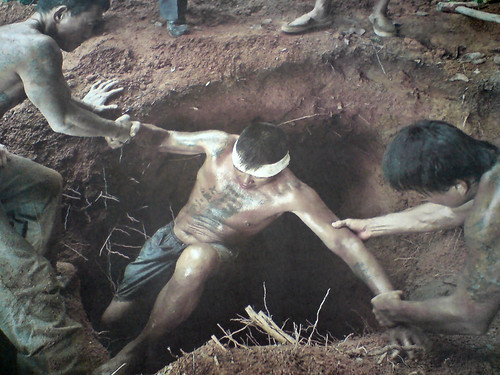 How does one end up with a particular job; does a job choose us, or we choose the job? The newspapers recently featured grave diggers who do what most people would avoid. The journalist wrote about one of them, an experienced man in his 50s who has become respected for his meticulosity in finding all the bone fragments.
Looking at the tattoos on their bodies, society's first reaction would likely be to label them as "failures". Failure in life is often linked to low education, low pay, and labour intensive work.
When I read the article, what came forth was the sense of dignity that the man has. He spoke about the importance of retrieving all bones and the skill of locating the depth and orientation of the remains. Is this a mere job for failures or has his Dedication made it a vocation?
Monday, December 22, 2008
Recollections
Though Michael died only in April this year, I felt motivated to read through again what I had wrote as a message of support to his family. Perhaps this is a time of Peace that invites me to recollect and draw strength for the coming year. A particular phrase stood out for me:
' ... your stories about how you "stood" on other's shoulders reminded me that I had been doing the same. And you have become one of the shoulders that I stand on too.'
I hardly knew Michael in person but somehow the knowledge of his works and the brief interaction with him has influenced the understanding of my own life. Over the years, I wonder how many other "shoulders" have I unknowingly stood on. Teachers, friends, classmates, platoon mates, colleagues, and even authors and playwrights whose books, plays, music or films have moved me in some ways. I seem not to be standing alone and feel my life is enriched and supported by others regardless whether they are aware of their contribution.
Friday, December 19, 2008
往生 - Towards life
 [往生], I heard this phrase used recently in a Taiwanese news broadcast and it caught my attention. Typically Singaporeans use the phrase 过逝 and call the deceased 逝者, both connote a meaning of disappearance (逝去,消失). Even the English word "decease" traces its roots to a meaning of departure. 往生 had its origins in Buddhist teachings that espouse living an earthly life aimed at attaining nirvana (极乐世界), a different level or dimension of life for lack of a better succint description.
I am reminded of this journey towards life after reading David Epston's re-membering of Michael White. He has not departed from his life journey but continues in a different dimension journeying with those who continue to use his ideas in their own work.
Subscribe to:
Posts (Atom)